
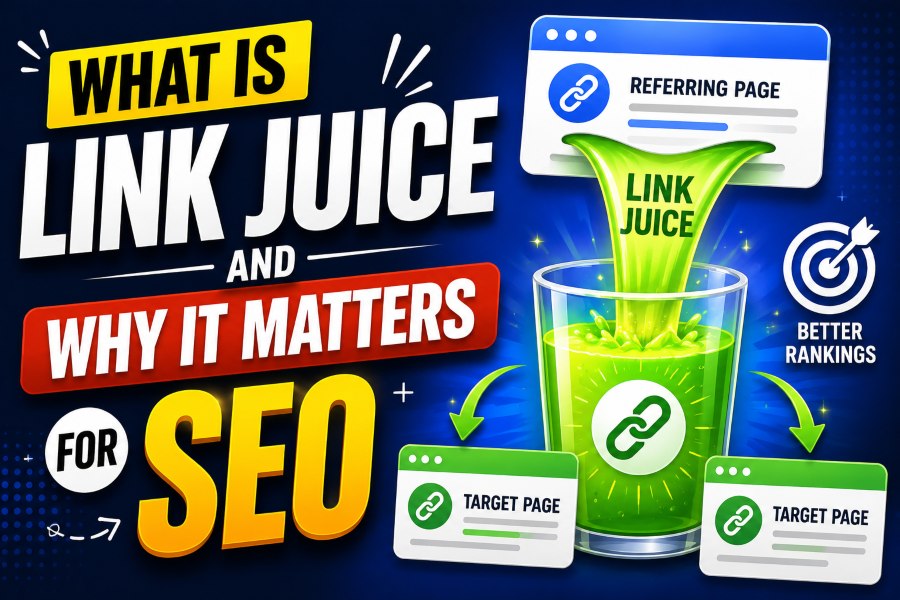
What is link juice is one of the most important questions you can ask when learning modern SEO and website authority. Search engines use links to discover pages, measure trust, and understand how authority flows from one page to another across the internet. When you understand how link juice works, you can improve rankings, strengthen internal pages, and create a smarter SEO strategy that produces long-term results.
Many website owners focus only on keywords and content while ignoring how authority moves through their websites. That mistake can weaken strong pages and stop valuable content from ranking properly in search engines. Once you understand how link juice flows, you can structure your website to naturally improve visibility, indexing, and organic traffic.
What Is Link Juice in SEO
Link juice refers to the SEO value or authority passed from one webpage to another through hyperlinks. Search engines treat links as signals of trust, which means a strong page can transfer some of its authority to another page through a relevant, properly placed link. This transfer of authority helps search engines determine which pages deserve higher rankings in search results.
Internal links and backlinks both pass link juice across websites and pages. A backlink from a respected website usually carries more authority than one from a weak or unrelated website with low credibility. Website owners who want to simplify internal linking for wordpress often use automation tools because managing authority flow manually becomes difficult as content libraries grow larger.
Link juice does not flow equally across every link on a page. Search engines evaluate page authority, topical relevance, anchor text, and the number of outbound links before deciding how much value should pass to another page. That is why strategic linking remains one of the strongest ranking factors in SEO today.
Why Link Juice Matters for Search Rankings
Search engines want to rank pages that appear trustworthy and valuable to users. Link juice helps search engines identify authoritative pages because quality links act like recommendations from other websites or important pages within the same domain. Pages with stronger authority often rank faster and maintain stable visibility in competitive search results.
Link juice also improves content discovery and indexing. When powerful pages connect to newer articles through internal links, search engines can crawl those pages faster and understand their relationship within your website structure. This process helps important content receive visibility instead of remaining buried inside a large website.
Websites with healthy link structures usually experience stronger engagement and lower bounce rates. Users naturally move between related pages when internal linking is helpful and relevant, which increases page views and improves the overall user experience. These behavioral signals can indirectly support stronger SEO performance over time.
How Internal Linking Passes Authority
Internal linking is one of the safest and most controllable ways to distribute link juice across your website. When you connect relevant pages together, you help search engines understand which pages are important and how different topics relate to each other. This structure improves crawling efficiency while strengthening weaker pages with authority from stronger content.
Anchor text plays an important role in internal linking effectiveness. Descriptive anchor text gives search engines context about the linked page while helping users understand what they will find after clicking the link. Website owners who want to take control of your website’s internal linking often focus on strategic anchor placement because proper internal structures improve both rankings and user navigation.
A strong internal linking structure usually follows topic clusters and pillar content strategies. Pillar pages target broad subjects while supporting pages cover specific subtopics connected through contextual links. This arrangement helps search engines identify topical expertise and improves authority distribution across related pages.
Best Internal Linking Practices
- Link to relevant pages naturally within content.
- Use clear and descriptive anchor text.
- Avoid excessive links inside one paragraph.
- Prioritize linking from high-authority pages.
- Update older content with new internal links regularly.
How Backlinks Influence Link Juice
Backlinks remain one of the strongest SEO ranking signals because they transfer authority from external websites. A backlink from a trusted industry website carries significantly more value than one from a spammy or irrelevant website. Search engines evaluate backlink quality carefully because unnatural linking patterns often indicate manipulation.
Relevant backlinks improve both authority and credibility. When respected websites mention your content naturally, search engines interpret those mentions as signals that your page provides value to readers. This process helps strengthen rankings for competitive keywords and improves long-term domain trust.
The placement of a backlink also matters. Links embedded naturally within useful content usually pass more value than links hidden in footers, sidebars, or unrelated directories. Search engines prefer editorial links because they are more likely to reflect genuine recommendations rather than artificial SEO tactics.
Factors That Affect Link Juice Flow
Several factors influence how much link juice passes from one page to another. Page authority remains one of the strongest elements because highly trusted pages usually transfer more SEO value than weaker pages with limited credibility. Search engines also analyze topical relevance because links between closely related topics appear more natural and useful.
Anchor text relevance can strengthen contextual understanding between linked pages. Website owners who want to discover internal linking opportunities often analyze content relationships carefully because strategic connections improve topical authority and user engagement at the same time. Relevant linking patterns help search engines understand the overall structure of a website more effectively.
The number of outbound links on a page can reduce the amount of authority passed through each individual link. A page with hundreds of outgoing links distributes its authority more thinly compared to a focused page with only a few highly relevant links. That is why quality and relevance matter more than link quantity.
Other Important Factors
- Follow versus nofollow attributes.
- Page crawlability and indexability.
- Content freshness and relevance.
- User engagement and click behavior.
- Link placement within the main content.
Common Link Juice Mistakes to Avoid
Many websites lose valuable authority because of poor internal linking structures. Orphan pages without internal links often struggle to rank because search engines cannot easily discover or understand their importance within the website. Broken links also waste authority and create negative user experiences that reduce trust.
Keyword stuffing inside anchor text is another common mistake. Search engines prefer natural anchor text that fits smoothly within content rather than repetitive keyword-heavy phrases designed only for manipulation. Over-optimized anchors may trigger spam signals and reduce ranking potential over time.
Ignoring topical relevance can also weaken SEO performance. Linking unrelated pages together confuses search engines and reduces the usefulness of your content structure for users. Effective linking strategies focus on relevance, readability, and logical content relationships instead of random authority distribution.
How to Build More Link Juice Naturally
The best way to build link juice is by creating content people genuinely want to reference and share. High-quality guides, original research, case studies, and useful resources naturally attract backlinks from bloggers, journalists, and industry websites. Valuable content earns authority more sustainably than manipulative link-building tactics.
Guest posting remains effective when done strategically and ethically. Writing useful articles for respected websites within your niche can generate relevant backlinks while increasing brand visibility and referral traffic. Search engines reward natural editorial links more than artificial link schemes designed only to manipulate rankings.
Content updates can also strengthen authority flow. Refreshing older articles with new information, improved structure, and additional internal links helps maintain relevance while redistributing authority across your website. Many successful websites increase traffic simply by improving existing content instead of publishing endless new pages.
Link Juice and Modern SEO Strategy
Modern SEO focuses heavily on authority, relevance, and user experience. Link juice supports all three areas because strategic linking improves navigation, strengthens topical authority, and helps search engines understand content relationships more effectively. Websites with strong authority structures usually outperform competitors even when targeting similar keywords.
Search engines have become more advanced in detecting unnatural linking patterns. Buying low-quality backlinks or participating in link exchanges may create short-term improvements, but these tactics often damage long-term trust and visibility. Sustainable SEO success comes from relevance, quality, and authentic authority growth.
Successful websites combine internal linking, quality content, and ethical backlink strategies together. This balanced approach creates a stronger foundation for rankings while improving user satisfaction and long-term organic growth. Businesses that invest in strategic authority building usually experience more stable search visibility over time.
Conclusion
What is link juice is no longer just a technical SEO concept because it directly influences rankings, visibility, and website authority in competitive search results. Understanding how authority flows through internal links and backlinks enables you to strengthen key pages, improve indexing, and enhance the user experience for your visitors. Once you build a smart linking structure with relevant connections and high-quality content, search engines can better understand your website and reward it with stronger rankings.
The most effective SEO strategies focus on relevance, trust, and long-term authority-building rather than shortcuts or manipulative tactics. Strong internal linking, high-quality backlinks, and useful content work together to create sustainable growth that benefits both users and search engines. When you apply these principles consistently, your website becomes easier to crawl, easier to navigate, and better able to rank for valuable keywords in your industry.